Using VMware FT

Another new feature of VMware vSphere 4 is the ability to use Fault Tolerance or FT. It is the ability to have real high availability, This is, with previous versions of VMware, we had DRS, that if a physical host went down, the virtual machines running on it, they run on another host, Foresaw a restart of the virtual machines. What VMware FT gives us is the possibility that virtual machines do not have to be restarted, and in case of ESX host crash with virtual machines, those that are protected with FT will continue to run on another host without loss of service.
How is this? When enabling FT on a virtual machine, the execution of a second virtual machine that is a copy of the first on another host is enabled in the background, leaving that machine as 'read-only', and its state will only change if the primary virtual machine fails, based on vLockstep technology. That's the good part, The bad, The requirements that FT has as of today, it is assumed that for future versions these requirements will disappear. Requirements:
– ESX Hosts must be version 4 or higher.
– There must be an HA cluster.
– The processor/CPU of those ESX hosts must be of the same family.
– Hyperthreading disabled.
– Logically the VM cannot have any physical device connected from the host (CD, PCI adapter, Floppy…)
– La máquina virtual debe estar en un almacenamiento compartido.
– Sólo 1 vCPU en la máquina virtual.
– Configurada una red para VMotion con 2 NIC por host.
– Configurada una red para Faul Tolerance Logging con 2 NIC por host.
– La máquina virtual secundaría estará en ejecución, esperando a que la primaria falle. Por lo tanto consumirá sus recursos, no como la primaria pero consumirá.
– Si tenemos DRS, las máquinas virtuales protegidas no se moverán de forma automática entre los hosts.
– No se pueden hacer snapshot en dichas MV, ni por lo tanto usar backups basados en snapshots (cómo VCB o DataRecovery).
– Dichas MV no podrán disponer de adaptadores USB ni dispositivos de sonido.
– No está soportado el uso de MSCS (Microsoft Cluster Services) dentro de la máquina virtual.
– We will not be able to use RAW or RDM, This is, map a LUN directly to these virtual machines.
– Regarding the use of virtual hard drives, they cannot be moved hot using Storage VMotion. Nor can they be Thin disks, otherwise, they will be Thick.
Once we meet the requirements, most of them logical, others like 1vCPU waiting for them to disappear… Continue.

First of all, When creating the virtual machine, keep in mind that the hard drive is configured to be used with Fault Tolerance, Marking “Support clustering features such as Fault Tolerance”.

We will need to have two adapters at 1 Giga for the FT log network among all ESX hosts, as well as one for VMotion.

Once we meet all the requirements, enabling FT is simple, sobre la máquina virtual que nos interese proteger, Right-click “Fault Tolerance” > “Turn On Fault Tolerance”,

Debemos confirmar que habilitaremos FT, “Yes”,

… esperamos unos segundos mientras habilita…

Y veremos la máquina virtual diferente, si pulsamos en ella y vamos a la pestaña de “Sumary” veremos que Fault Tolerance está habilitado, ya que indica que la MV está protegida.

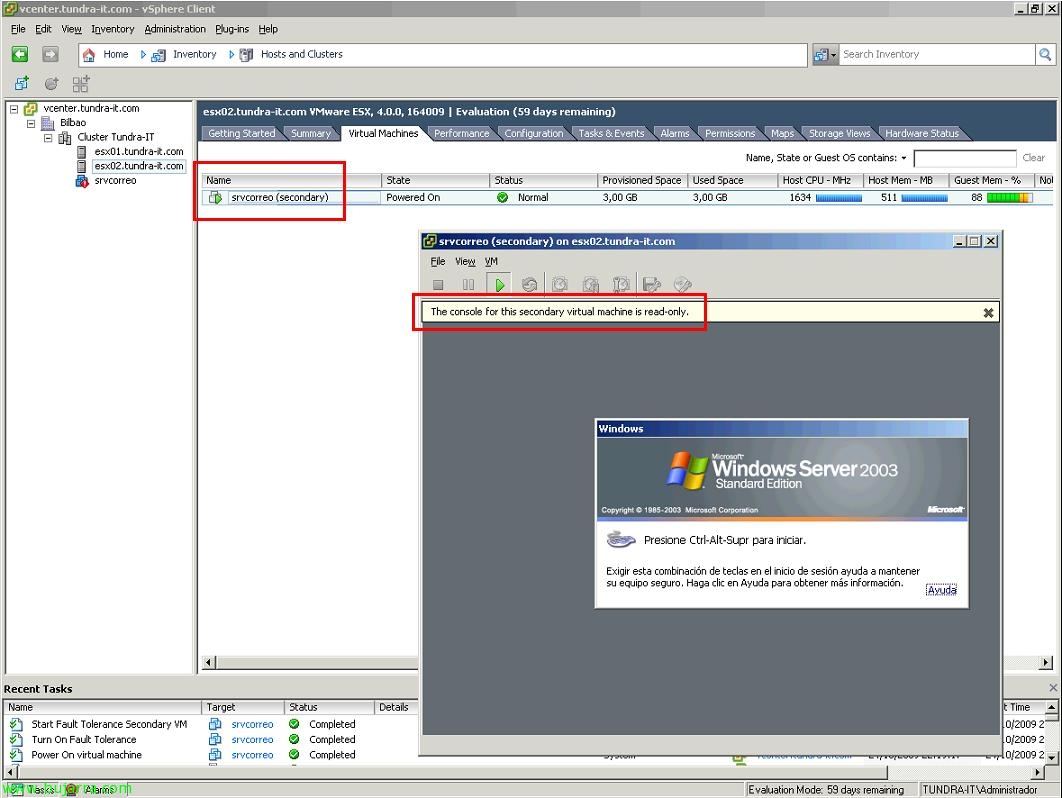
Si nos vamos al host que indica cómo “Secondary Location”, veremos que sale la máquina virtual en “Virtual Machines” cómo secundaria, y si abrimos su consola será sólo en modo lectura.
By the way, si queremos probar a habilitar FT en un entorno donde los servidores ESX sean virtuales, habrá que modificar el fichero .vmx de la máquina virtual a proteger añadiendo esto en su configuración:
replay.allowBTOnly = TRUE